
Hindustani
Riyaz with Sadhana AI
Written for someone doing daily riyaz in the Hindustani tradition. The app is not a Carnatic app with Hindustani labels pasted over it — the swara naming, the drone and the rhythm model are configured for this tradition — but there is one place where support is genuinely thinner, and it is named below rather than buried.
Bhatkhande sargam, properly spelled
Notation follows Bhatkhande convention rather than Carnatic convention. The distinction is not cosmetic: it is how you read a bandish at a glance.
- Komal swaras are written lowercase — re, ga, dha, ni as
r,g,d,n. - Shuddha swaras are uppercase —
S R G m P D N. - Tivra Ma is uppercase
M, against shuddha ma as lowercasem. Kalyan and Yaman read correctly instead of needing a mental translation. - Octave marks distinguish mandra, madhya and taar saptak.
The full twelve, by pitch class from Sa:
S r R g G m M P d D n N.
The tanpura: Sa and Pa
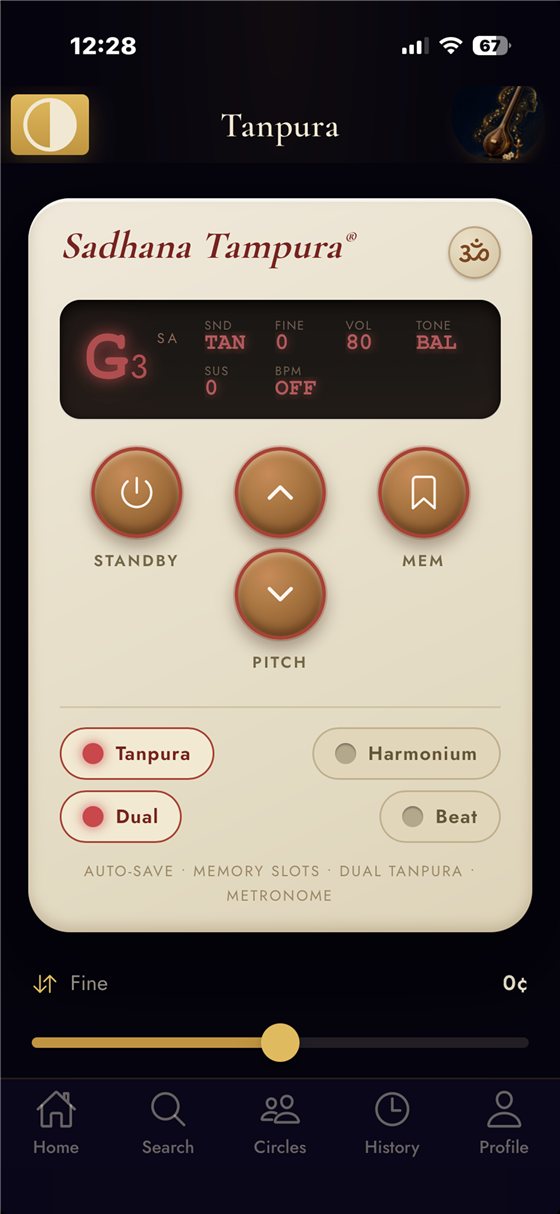
The drone for melodic Hindustani practice sounds Sa and Pa, which is the pairing most raags assume. Set it to your Sa and leave it running — it keeps sounding while you move to other screens, so one tap covers a whole riyaz session.
For raags that want Ma rather than Pa, treat the drone as a reference rather than an accompanist and use your ear for the rest; the app does not currently offer a Sa–Ma tanpura preset.
Taal, not a bare click
Rhythm is modelled as taal — a cycle with a structure — rather than as a time signature. The metronome shows where you are in the cycle, which is the information that matters when a bandish starts off the sam.
Start slower than feels necessary. The common failure in riyaz is not a wrong swara, it is arriving at the sam a fraction early for weeks without noticing.
What the app hears, and what it cannot judge
It measures
- Whether you held Sa or drifted off it.
- Where a recorded phrase sat sharp or flat against a reference, swara by swara.
- Timing against the taal you set.
- Interval and swara recognition, in ear training.
It does not judge
- Meend, kan, andolan, gamak. It sees the pitch movement; it has no opinion on whether the meend was shaped well.
- Whether your alap developed the raag properly.
- Badhat, bhav, or the choice of a phrase.
- Whether you are observing the raag's samay or its chalan.
Raag identification — the honest caveat
You can hand the app a recording and it will estimate the Sa and suggest the most likely raag. It is useful. It is also the one feature where Hindustani support is thinner than Carnatic: the raga engine was developed and tuned primarily on Carnatic material.
Expect it to be less sure-footed on Hindustani recordings, and more so where a raag shares its scale with others and is distinguished by chalan, vadi–samvadi emphasis and characteristic phrases rather than by its note set. Treat a suggestion as a second opinion worth checking, never as a ruling. Everything else on this page — the drone, the taal, the sargam, the pitch comparison, the notation, the ear training — carries across without that asterisk.
Instruments, not only voice
Hindustani instrument modes ship alongside vocal, each with its own notation and reference setup:
| Mode | Notation | Reference tool |
|---|---|---|
| Vocal | Bhatkhande sargam grid | Tanpura on Sa and Pa |
| Bansuri | Bhatkhande sargam grid | Tanpura on Sa and Pa |
| Violin (Hindustani) | Bhatkhande sargam grid | Tanpura on Sa and Pa |
| Tabla | Bol grid — strokes, not swaras | Drone on Sa |
Tabla is deliberately different: a bol grid writes strokes rather than pitches, because notating tabla as melody would be nonsense. Note that percussion transcription is a harder problem than monophonic melody, so expect more correction there.
A riyaz session
- Tanpura on, set to your Sa. Leave it.
- Taal on, slower than you want it.
- If one phrase of the bandish keeps collapsing, isolate it with loop practice — slow it down without the pitch dropping, and shift it to your Sa if the recording is in someone else's.
- Record the phrase and look at where the pitch actually went. Ignore the flags on ornamented swaras; attend to the plain ones that drifted.
- Keep the take. Next week you can hear whether it moved.
A daily puzzle, free and public
Three free puzzles a day in their Hindustani versions: Ragadle (guess the mystery raag in six tries, each guess lighting up the swaras it shares with the answer), Sur Connections (sixteen tiles, four hidden groups of four) and Raag Ladder (turn one raag into another, one swara per rung, every rung a real raag). The Hindustani versions draw on Hindustani raags, so you are not asked to place Carnatic melakartas. New at midnight IST, no account needed.
Useful for recall and recognition; it does nothing for your sur. See the daily games guide, or play today's.
Questions
Is this just the Carnatic app relabelled?
Partly, and it is fairer to split the answer. Genuinely Hindustani: notation, sight reading and play-along use Bhatkhande sargam — komal lowercase, tivra Ma uppercase — which is a different swara set from the Carnatic one; rhythm is modelled as taal; and the drone sounds Sa and Pa. Still Carnatic-flavoured: the Analyze screen, the swara circle, the pitch graph and the PDF report label swaras in Carnatic style whatever tradition you pick, and the raga identification was trained on Carnatic material. The underlying pitch engine is shared, which is as it should be — pitch is pitch.
Can I get a Sa–Ma tanpura?
No. The melodic drone is configured for Sa and Pa.
Does it teach raags, or paltas and alankars in order?
No. There is no graded syllabus and no built-in course of paltas, alankars or bandishes. The app gives you tools, exercises and measurement; the material and its order come from your guru.
Will it tell me if my meend is good?
No, and be wary of anything claiming it can. It measures pitch over time, so it sees the slide. Judging it is musicianship.