
Pitch and swaras
Checking your shruti and swara accuracy
There are two different things here and conflating them causes most of the confusion: a live tuner that tells you about the note you are producing right now, and an analysis of a take you have already recorded.
Live: the tuner
The tuner responds as you sing or play. Hold a swara and watch where it sits. This is the right tool when you want immediate, unambiguous information about one sustained note.
The most useful exercise: start the drone at your kattai, sing Sa, and look. Then sing the swara you suspect you get wrong. Many singers are consistently a few cents low on one particular swara and have never been told.
After the take: note-by-note comparison
Record yourself singing against a reference and the app compares the two, marking where you sat sharp or flat across the phrase. You get a shape — where in the line it went wrong — rather than a single number, which is what makes it actionable.
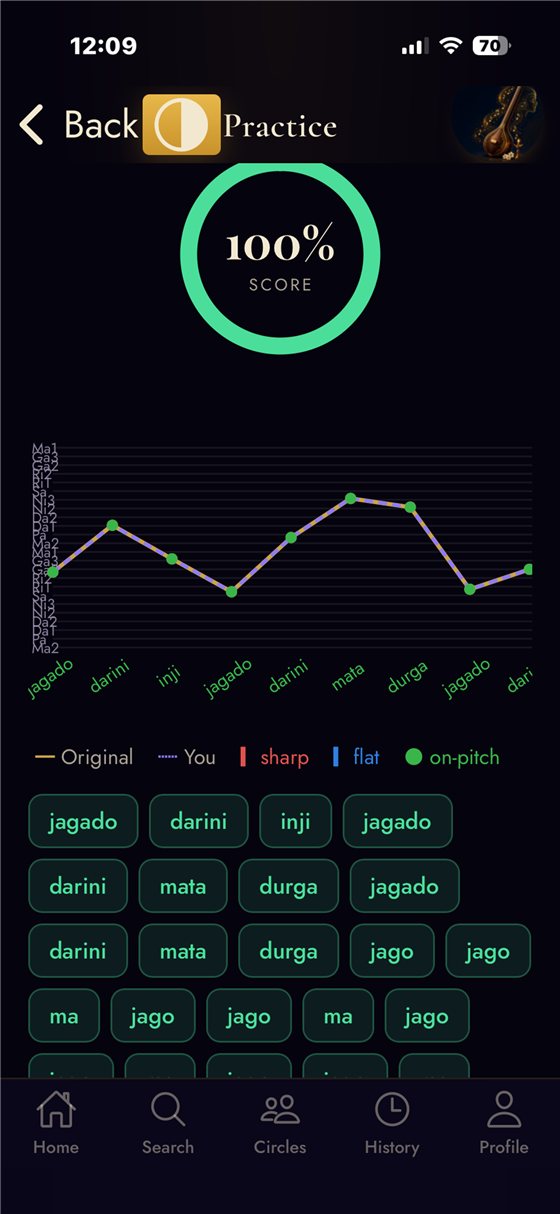
What a flagged note actually means
It means the measured pitch differed from the reference by more than a tolerance. That is all it means. In particular it does not mean you sang badly, and here is why that distinction matters:
- Ornamented notes flag more than plain ones. A gamaka is pitch movement by design. A meter that compares against a target pitch reads movement as deviation. In Carnatic and Hindustani music this is not a bug you can tune away; it is the nature of measuring ornamented music against a point value.
- A different valid interpretation will flag. If your reference take phrases something differently from how you were taught, the app marks the difference, not the error.
- Recording conditions matter. Background noise, a distant microphone and accompaniment bleeding into the vocal all degrade pitch tracking.
Identifying shruti and raga from a recording
Separately from comparison, the app can take a recording and estimate its Sa and its most likely raga, laying out the swaras it heard.
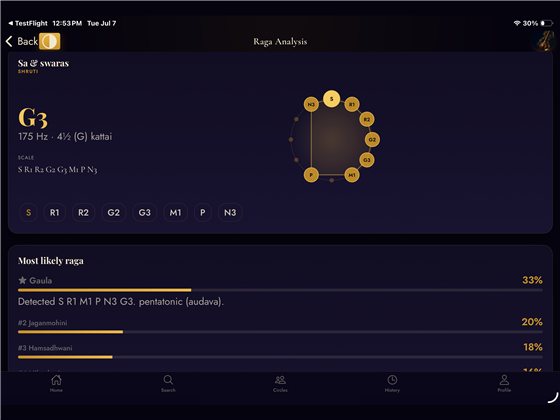
Raga identification from audio is hard in a way that is worth respecting. Allied ragas can share a scale and be distinguished mainly by prayoga and emphasis; short clips and noisy recordings give the system less to go on. Read the result as a well-informed second opinion.
What is not measured
Stated plainly so nobody buys the app expecting it: there is no assessment of gamaka correctness, voice quality, breath control, bhava, laya sense beyond timing against a metronome, or overall musicianship. No score in this app should be read as a judgement of how well you sing.